


AUToLooP:
More circularity in Austrian vehicle and component production
The project
End-of-life vehicles are an important resource, but their potential is still largely untapped. A considerable share of vehicles and vehicle components is exported, and valuable raw materials and regional value creation are lost to Austria as a result. The new EU End-of-Life Vehicles Regulation (Regulation (EU) 2026/1738) entered into force in August 2026 and sets, among other things, mandatory recycled content targets for plastics. This significantly increases the pressure on Austria to act, including in the vehicle industry.
The AUToLooP project therefore aims to significantly increase the share of recycled materials in Austrian vehicle and component production. The project runs from May 2026 to April 2027 in three steps:
- Status quo assessment: We identify the actors along the Austrian value chain and trace how materials flow through the entire supply chain.
- Co-creation workshop: Together with practitioners, we use a SWOT analysis to identify opportunities, barriers, research needs and measures.
- Practical measures: Based on these results, we develop a prioritised catalogue of concrete recommendations for industry, policy and research.
AUToLooP is a project of the University of Graz together with alchemia-nova research & innovation gGmbH and AVL List GmbH. It is commissioned by the Austrian Federal Ministry for Innovation, Mobility and Infrastructure (BMIMI) and funded by the Austrian Research Promotion Agency (FFG).
Why now?
From 2032, new vehicle types must contain at least 15% recycled plastic from post-consumer waste, rising to 25% from 2036. Previous studies for Austria, Germany and the EU put this share below 2%.¹ We investigate how this gap can be closed effectively in Austria.
¹ Maury et al. (2023), JRC report JRC129008; Lindner et al. (2022), “Facts Matter” project, ecoplus; Potrykus et al. (2024), German Environment Agency, Texte 24/2024.
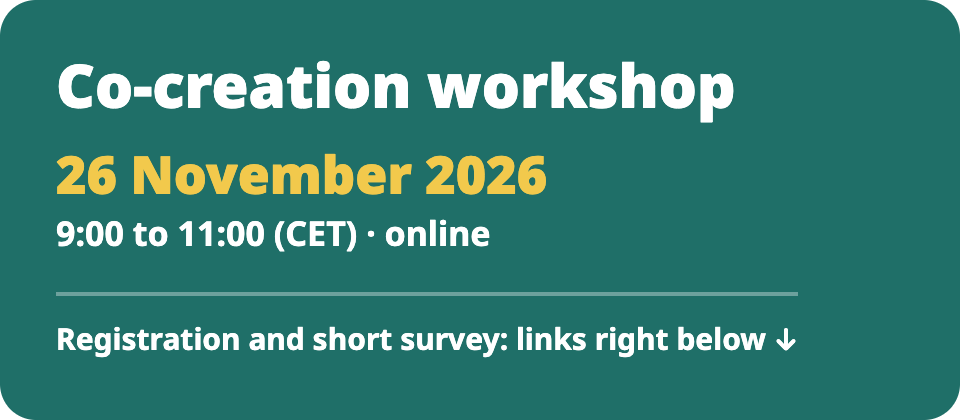
Co-creation workshop on 26 November 2026, 9:00 to 11:00 (CET), online
In a co-creation workshop with actors along the value chain, we will carry out a SWOT analysis on the circularity of vehicles and components in Austria and derive concrete measures, which will feed into a prioritised catalogue of recommendations. This includes the question of who needs to act where: companies, policymakers, associations or research. The workshop gives actors from the Austrian value chain the opportunity to help shape policy measures that aim to advance the circular economy in practice.
If you are interested in taking part in the co-creation workshop, please register via the following link:
Register for the workshop → https://surveys.uni-graz.at/859812?lang=de
You will receive the link to the online meeting by e-mail after registering.
Please note: The workshop will be held in German.
Short survey
Would you like to share your views and expertise in advance, or are you unable to attend the workshop? Our short survey (about 5 to 10 minutes) asks how you assess the potential for circular economy in your field, where you see the main barriers and which measures would help to remove them, in order to promote the circular economy in the Austrian vehicle industry and make use of untapped potential. The survey is aimed at companies as well as associations, public administration and research. The results will feed into the workshop. Participation is anonymous.
Please note: The survey is available in German only.
Take the short survey → https://surveys.uni-graz.at/224912?lang=de
Progress so far
In the first project step, we assessed the current situation. We reviewed 63 publications, mapped 126 companies along the value chain and conducted 16 expert interviews. Using a material flow analysis, we calculated the main material flows and show how much material went into Austrian vehicle and component production in 2024 and what happened to end-of-life vehicles, among other things.
A key finding of our analysis: 95.7% of the vehicle parts and materials produced in Austria (by mass) are exported. Of the vehicles deregistered in 2024, only about 15% were treated in Austria. The whereabouts of the remaining 85% are unknown. As a result, the Austrian material cycle loses considerable amounts of potential secondary raw materials that would be highly important for building up and securing a national stock of secondary materials.
Best practices
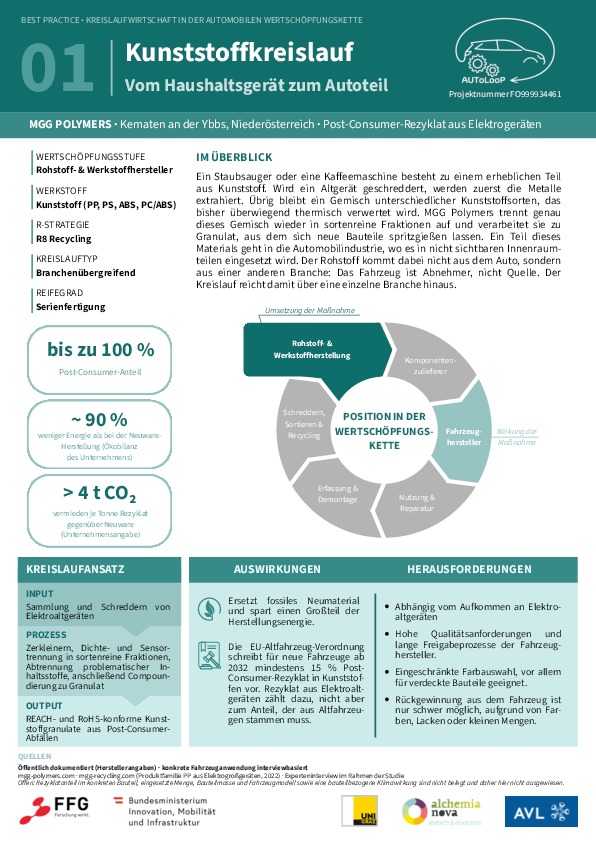
Alongside this work, we collected examples that show how circular economy already works in vehicle production today. They range from processing aluminium scrap and recycling car glass to recovering metals from shredder residues. The examples come from Austria and abroad and cover the value chain from material production to recycling. Each example is summarised in a factsheet.
Please note: The factsheets are available in German only.
Project information
Project type: FFG project (R&D service)
Funding: commissioned by the BMIMI, funded by the FFG
Duration: 01.05.2026 – 30.04.2027
Coordination: alchemia-nova GmbH
Project partners: alchemia-nova GmbH (AUT) / University of Graz (AUT) / AVL List GmbH (AUT)
Project lead at the University of Graz: Martina Zimek (Department of Environmental Systems Sciences)
Contact
Martina Zimek (martina.zimek(at)uni-graz.at) & Sophie Franz (sophie.franz(at)uni-graz.at)
Department of Environmental Systems Sciences, University of Graz